
“Honda’s design philosophy stresses function - KIVI-TV” plus 4 more |

- Honda’s design philosophy stresses function - KIVI-TV
- Larry Johnson Gamble Shows Bold New Philosophy from Bengals Management - Bleacherreport.com
- The Secret And Philosophy Of Hajj - Daily Guide
- Thierry Henry and football philosophy - The Guardian
- Home Spirituality Philosophy Purpose: The Heartbeat of Creation (Part ... - Aish
| Honda’s design philosophy stresses function - KIVI-TV Posted: 20 Nov 2009 12:14 PM PST Honda isn't typically singled out for its design expertise. Instead, it is the fun-to-drive and rock-solid aspects of Honda vehicles that usually get top billing. But quietly, Honda has been capturing more and more international kudos for its leading-edge design work, and we were pleased to have the opportunity to meet with Nobuki Ebisawa, the corporate managing director and general manager of styling and design development, to talk about it. Ebisawa stressed two simple and overarching themes for Honda design: dynamism and functionality. He said the company's designers still draw inspiration from the functional designs of the first-generation Civic and first-generation Accord that were drawn in the same nondescript design studio in which Ebisawa and his crew work today. And at the same time, they look back all the way to the 1963 S500 sports car to channel the dynamism that helps set the brand apart. Ebisawa is proud of what he calls "an unbroken chain of dynamism and functionality" that stretches from those earliest models through the legendary Acura NSX sports coupe of the '90s to the Honda Odyssey minivan that transformed its segment. He expects that the upcoming hybrid Honda CR-Z, which was shown in concept form at the recent Tokyo Motor Show, will draw on both aspects of the Honda personality. Functionality will be characterized by the fuel-efficient hybrid drivetrain, and dynamism will be expressed by the car's style and fun-to-drive nature. While the exterior design of Honda vehicles has not always been highly praised, the interior of its vehicles -- and especially their instruments and controls -- have routinely been lauded around the globe. Ebisawa cites his group's intense study of the "man-machine interface" for this, noting that Honda has long relied on the philosophy "Man maximum, machine minimum" in its designs. This means that Honda's controls are intended to be intuitive, not intrusive: to help the driver, not to challenge the driver or to make a design statement for design's sake. An example of this effort is the bi-level instrument panel seen on the current Honda Civic. Intuitive operation and instant recognition were keys in the design, and Ebisawa said that in the "layered construction," perceived space is enhanced and line of sight movement minimized to prioritize information. Special effort goes into achieving natural hand position and create buttons that are easily understood. Ebisawa believes that voice support is the next frontier in making things simpler and more functional. Since 2000, said Ebisawa, Honda design execs made the conscious decision to add emotional appeal to the company's vehicles without compromising functionality. In keeping with the "man maximum, machine minimum" philosophy, space has been intentionally reduced for mechanical components, and interior space with long rooflines has been increased to maximize usable roominess. The Honda CR-Z, which will be launched next year, will encapsulate all these ideas in a vehicle that is functional and emotional, dynamic yet pragmatic. It draws on Honda's long heritage while at the same time presenting a new face and a new heart. The CR-Z will also be the harbinger of even more fascinating products from the carmaker that was once best known for its motorcycles. Tom Ripley Driving Today Contributing Editor Tom Ripley writes frequently about the auto industry and the human condition from his home in Villeperce, France. He is a big fan of the art world. Copyright (c) 2009 Studio One Networks. All rights reserved. This content has passed through fivefilters.org. | ||
| Larry Johnson Gamble Shows Bold New Philosophy from Bengals Management - Bleacherreport.com Posted: 20 Nov 2009 12:42 PM PST A lot has been made of the Cincinnati Bengals' decision to sign troubled ex-Chiefs running back Larry Johnson. Monday, Bengals.com columnist Geoff Hobson correctly predicted it will be "debated hotly through the hills and valleys of Bengaldom."
Some see it as a great move, gaining insurance for the playoffs, especially since feature back Cedric Benson is nursing a hip injury.
Others think Cincinnati is introducing a locker-room cancer into a close-knit team, torpedoing what has been a special season thus far.
And some figure it can't hurt, because, at a pro-rated league-minimum salary, Johnson costs the Bengals nothing to cut if he's a problem.
Lost in all this speculation, though, is what the move says about Bengals management. It's easy enough to talk about Johnson as a huge gamble, but that really puts the focus on Johnson and not the Bengals.
The truth is signing Johnson says very good things about how the Bengals are managed.
Pretend for a second it wasn't Larry Johnson the Bengals acquired. Pretend it was anyone else who could play reasonably well and add some depth to a position that would be frighteningly thin if the starter went down.
At 7-2 with seven games to play, the Bengals saw themselves in position to make a move. Two things could probably derail a playoffs run in a matter of seconds—losing Carson Palmer and losing Cedric Benson.
So there were the Bengals minding their own business when, suddenly, a two-time Pro Bowl running back hit the market. "You know," head coach Marvin Lewis likely thought, "if that guy is willing to do things the way we want here, he could really contribute to us making a deep run at a championship."
And when did that thought occur to Lewis? Last Thursday. Before Benson got hurt.
There's a new way of thinking in Cincinnati. The Bengals have decided they are going to do what is necessary to win games. We saw it from the coaches in the offseason. We've seen it from the players during the season. Now, management is getting in on the act. Owner Mike Brown pulled the trigger on a controversial deal because it just might earn him something his father never had—a Lombardi Trophy.
This is aggressive, win-now thinking. It's the kind of move the Patriots have made (Corey Dillon? Randy Moss, anyone?) multiple times. Ask Robert Kraft how it's worked out for him.
It's unclear right now whether Johnson can make good on his last chance the way Dillon and Moss did, but the Bengals management team should be praised for stealing a play from Bill Belichick and Co.
If it works, this little controversy will be forgotten, as, in the words of Bengals founder Paul Brown, "winning makes believers of us all." This content has passed through fivefilters.org. | ||
| The Secret And Philosophy Of Hajj - Daily Guide Posted: 20 Nov 2009 11:16 AM PST |
1. The Ethical Dimension The most important philosophy of Hajj is the ethical transformation which it induces within man. The ritual of 'ihraam' entirely removes man from material ostentations, external distinctions, extravagant apparels and ornamentations, and by prohibiting pleasures and engaging him in self-rectification - one of the duties of a 'muhrim' , it distances him from the material world and engrosses him in a world of light, purity and spirituality, consequently causing those, who, in ordinary circumstances, find themselves to be weighed down by the burden of make-believe distinctions, ranks and honors, to suddenly feel light, easy and relaxed. Subsequently, the performance of the other rituals of Hajj, one after the other, continually brings man closer to his Lord, strengthens his spiritual connection with Him, distances him from his gloomy and sinful past, and guides him towards a bright, luminous and pure future. In view of the fact that every step of the Hajj-rituals is reminiscent of the events associated with Ibrahim, Ismaai'l and his mother Haajar, and personifies before man their self-sacrifice, altruism and struggle (in the path of God), and also given that the city of Mecca - in general - and the Masjid al-Haraam, the Ka'bah and the place of circumambulation - in particular - bring to mind the memories of the Holy Prophet (peace be upon him and his holy progeny), the holy Imams (peace be upon them) and the struggle of the Muslims during the period of early Islam, this ethical transformation tends to be deeper and more profound such that in every corner of Masjid al-Haraam and the city of Mecca, man visualizes the faces of the Holy Prophet (peace be upon him and his holy progeny), A"li (peace be upon him) and the other holy Imams (peace be upon them), and hears the enthusiastic slogans of their mission. Indeed, all these together pave the way for an ethical revolution within hearts that are receptive and in a manner that is indescribable, and causes man to turn over a new leaf and opens up a new chapter in his life. And it is not without reason that we read in our traditions that one, who performs Hajj, completely and perfectly… (Becomes free of sins just as he was on the day when his mother gave him birth) . Truly, Hajj is a second birth for the Muslims - a birth which is the beginning of a new human life. It is needless to mention that these effects and benefits, and those that we shall mention later, are neither for those who only content themselves with its exterior leaving aside its core, nor for those, who only view it as a means for recreation, tourism, pretension, dissemblance and acquiring personal material items - never acquainting themselves with its spirit and essence. Their share would only be that, which they had set out to achieve! 2. The Political Dimension: As has been stated by one of the renowned Islamic jurisprudents, the Hajj rituals, apart from putting on display the most sincere and profound acts of worship, are also the most effective means for advancing the political objectives of Islam. The essence of worship is attention towards God, while the essence of politics is attention towards the 'creation of God' - and these two aspects are observed to be as closely intertwined in Hajj as the yarns in a fabric! Hajj is an instrument to combat nationalistic and racial fanaticism, and oppose confinement (of the Muslims) within their geographical boundaries. Hajj is a means for eliminating the shackles of censorship and breaking the stranglehold of the oppressive leaderships prevalent in the Islamic nations. Hajj is a tool for transferring news of political affairs of the Islamic nations from one corner of the globe to another, and finally, it is an effective means for breaking the fetters of captivity and colonialism, and liberating the Muslims. And it is for this reason that, during the period when oppressive tyrants like those belonging to the Umayyad and the Abbasid dynasties ruled over the Islamic regions and kept every kind of interaction between the various segments of the Muslims under close scrutiny in order to crush any kind of liberty-seeking uprising, the advent of the season of Hajj was an opening towards freedom, interaction between various segments of the great Islamic society and discussion of various political issues. And it is on this basis that Amirul Mu"mineen (peace be upon him), expounding the philosophy that lay behind every act of worship, in connection with Hajj states: (Allah has ordained (the rituals of) Hajj for the purpose of strengthening the religion) . Again, it is not without reason that an eminent non-Muslim statesman has stated: Woe unto the Muslims if they do not perceive the meaning (and significance) of Hajj and woe unto their enemies if they (the Muslims) ever happen to perceive it. Even in the Islamic traditions Hajj has been regarded as the jihad of the feeble ones – one, in which even the old and weak men and women can join in and have a contribution in exhibiting the greatness and grandeur of the Islamic ummah and, by standing in circles around the holy Ka'bah and attesting to God's unity and greatness, cause the hearts of the enemies of Islam to palpitate in trepidation. 3. The Cultural Dimension The interaction between the various segments of the Islamic society during the season of Hajj can turn out to be the most effective factor for cultural exchanges and transfer of thoughts and ideas. This is especially so in view of the fact that the grand gathering of Hajj is in reality, a true and natural representation of all the segments of the Muslims of the world (since there is no forced, forged or artificial factor involved in the selection of those proceeding for Hajj, the Pilgrims are individuals that come from all segments, races and languages associated with the Muslims all over the world, who have gathered under one roof). And this is why we read in the traditions: One of the benefits of Hajj is the spread of the traditions of the Holy Prophet (peace be upon him and his holy progeny) throughout the entire Islamic world. I questioned the Imam (peace be upon him) about the philosophy that lay behind the performance of Hajj and the circumambulation of the Ka'bah whereupon he (peace be upon him) replied: "God created the servants … and for the welfare of their worldly and religious affairs, He sent down His commandments for them - one of them being the congregation of the people from the East and the West (for the Hajj rituals). This, in order that the Muslims become acquainted with one another, become aware of the states of each other, and (so that) every group transfers its business investments from one city to another … and in order that the memories and traditions of the Holy Prophet (peace be upon him and his holy progeny) become known, and the people bring them to mind and do not forget them." And it was on this basis that the Muslims, during the suffocating eras in which the tyrannical caliphs and rulers had prohibited them from spreading these rulings, made use of this opportunity (of Hajj) to interact with the Imams (peace be upon them) and eminent religious scholars for solving their problems, understanding the rulings of Islam and comprehending the traditions and customs of the Holy Prophet (peace be upon him and his holy progeny). On the other hand, Hajj possesses the ability to be transformed into a gigantic cultural assembly in which scholars and intellectuals of the Islamic world, coming together for a few days in Mecca, propound their thoughts and exhibit their creativity before the others. Essentially, one of the great catastrophes is that the boundaries between the Islamic nations become reason for them to become separate from each other, culturally. As a consequence, Muslims of each nation only reflect upon their own selves and their own state of affairs, and this is something that effectively works towards dismembering and dissecting the single Islamic society; indeed, Hajj has the ability to stem this evil outcome. And how beautifully has Imam Sadiq (peace be upon him) stated in that tradition of Hishaam Ibn Hakam when he said: If all the people were to be concerned only about their respective countries and the problems existing therein, all of them would suffer destruction, their countries would face ruination, their benefits and welfare would be lost, and realities would become obscured and concealed. 4. The Financial Dimension Contrary to what some people imagine, utilizing the great assembly of Hajj for strengthening the financial foundations of the Islamic nations is not only not inconsistent with the spirit of Hajj but, according to the Islamic traditions, constitutes one of the philosophies for it, instead. What is the harm if the Muslims, in that great gathering, were to lay the foundations of a common and associated Islamic market, and pave the way for commercial transactions amongst themselves in a manner such that neither do their profits enter the pockets of their enemies nor does their economy become dependent upon the others; and if such is the case, not only is this not 'craving for the world' but rather, an act of worship and jihad (in the way of God). And it is for this reason that in that tradition of Hishaam Ibn Hakam from Imam Sadiq (peace be upon him), an express reference has been made towards this aspect that one of the objectives of Hajj is strengthening the commerce of the Muslims and facilitating economic association and cooperation amongst them. In another tradition, Imam Sadiq (peace be upon him), interpreting the verse... (There is no blame on you in seeking bounty from your Lord) says: The meaning of this verse is 'seeking livelihood'. (And when a person comes out of his ihraam and completes the Hajj, he should conduct business transactions during the season of Hajj (for not only it is not a sin but on the contrary it carries rewards.)) This meaning is also witnessed in a tradition from Imam A"li Ibn Musa al-Ridha (peace be upon him) which explicitly enumerates the philosophies and objectives underlying the rites of Hajj; in the tradition, the Imam (peace be upon him) recites the following verse of the holy Qur"an: (That they may witness advantages for them) , a reference to the fact that the verse alludes to the spiritual benefits as well as the material ones - although both of them, from one perspective, can be looked upon as being spiritual in nature. In short, if this great worship were to be utilized correctly and perfectly, and the Pilgrims of the House of God, at a time when they are active and their hearts are emotionally ready in that holy land, were to make use of this great opportunity for solving the various problems that plague the Islamic society by establishing various political, cultural and mercantile assemblies, it would surely serve to untie the knots and solve the problems; and perhaps this is why Imam Sadiq (peace be upon him) has said: (The religion shall continue to stand for so long as the Ka'bah continues to do so) And it is due to the immense significance of the above issue that in the Islamic sources of traditions a separate chapter has been devoted to it that if it were to ever happen that in a particular year the Muslims decide to refrain from going for Hajj, it would become obligatory upon the Islamic government to send them to Mecca by means of force!  This content has passed through fivefilters.org. | |
| Thierry Henry and football philosophy - The Guardian Posted: 20 Nov 2009 09:50 AM PST 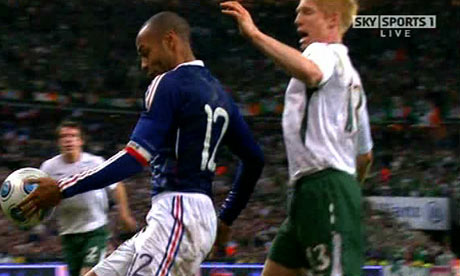 La main de Dieu: Thierry Henry's handball in the build-up to France's decisive goal against the Republic of Ireland in Paris. 'I will be honest, the ball hit my hand,' admitted Henry later. Photograph: Sky Sports La main de Dieu or la main du diable? After Zidane's headbutt, we now have Henry's hand. On Wednesday evening, judging from the noise on the streets of Paris, cars horns honking as though we had won the World Cup, I assumed France was scoring one goal after another against Ireland. I had to check to make sure, but no, France was actually being led by Ireland. So why the fuss? I enquired further. The true victors that night were, in fact, the Algerian team who had just beat Egypt, getting through to the World Cup, for the first time in 34 years, or so I read. From my balcony, I saw dozens of Algerian flags proudly floating from cars on their way to the Champs Elysées. Then, a couple of hours later, I learned of Thierry Henry's handball and all hell broke loose. Bitter victory. The morning after felt even worse, with an overwhelming majority of the French media displaying cynicism at such a lacklustre performance from the French team and such an inglorious outcome. L'Equipe, the national sport daily, was the harshest: "It was already a miracle [for France] to have survived two hours of such an abysmal and nonexistent game comprising little boys' passes and very ordinary players' timidity. A miracle indeed to have survived all the Irish opportunities throughout a match that will go down in history as the biggest failure for our national team. [...] These two hours prove that Les Bleus don't make a great team; can we actually call them a team at all?" If you want to get some more French self-flagellation, just open any French daily and drink down their words, which could hardly get any more bitter. You could also listen to any French politician, including virtually any government minister. On Friday morning, interviewed one by one, they all in turn deplored their national team's victory. When did this last happen? Economy minister Christine Lagarde even called for a rematch, and so did many others, such as opposition leader François Bayrou. The angst reached an altogether more profound stage, an existential crisis even, when philosophers were asked their opinion on the situation, which, by now, had become "une affaire d'état". Alain Finkielkraut, a keen football supporter, like most French thinkers, declared that he was sad and felt embarrassed. He thought the Irish had been "extraordinary" and that the referee found himself in an "untenable" position. He reminded us, however, that the public may see everything thanks to video and slowmotion replays, but that players and referees are down on the field with only their eyes to assess a situation in real time. "Henrygate" has thus become "un cas de conscience". Thierry Henry has apologised and Fifa has ruled. Ireland deserved to go to the World Cup. As with Henry, so the French know this and regret it. It is ironic, to say the least, that all this occurred in the week that Nicolas Sarkozy, in a typically showy gesture, announced his desire to see the ashes of writer, philosopher and keen goalkeeper Albert Camus installed in the Panthéon. And what would Camus have made of this episode worthy of an absurdist drama? Our only clue is what he told an alumni magazine about his experience playing for his (French Algerian) university team: "What I know most surely about morality and the duty of man, I owe to sport." It is a pensée on which France is reflecting this weekend. This content has passed through fivefilters.org. | ||
| Home Spirituality Philosophy Purpose: The Heartbeat of Creation (Part ... - Aish Posted: 20 Nov 2009 09:29 AM PST Click here to read the first part of this series. Judaism begins with the belief in a Creator of the entire universe. The history of our people commences with Avraham's question, "Who created the world?" (cf. Bereishis Rabbah 39:1). That question led him to the recognition of God as the Creator. God existed prior to Creation, and that Creation remains dependent upon Him. Creation came into being as an expression of His will and is dependent on Him; it continues to exist only by virtue of a continued infusion of His creative energy. This is stated in the first of the Thirteen Principles of Faith based on Maimonides: "The Creator, Blessed is His Name, creates and guides all creatures, and He alone created, creates, and will create everything." Intelligent beings do not act without some purpose, and certainly the Supreme Intelligence must be assumed to act in a purposeful fashion. Now, if God created the world and continues to sustain it, He must have had some purpose. Intelligent beings do not act without some purpose, and certainly the Supreme Intelligence must be assumed to act in a purposeful fashion. Prior to Creation, God was complete unto Himself. He had no need for the world, for He lacked nothing. Indeed, as the Kabbalists put it, He had to make room for the world, as it were, through an act of voluntary contraction. Creation, then, has a goal. A crucial corollary to this belief is: God created the world in such a way as to ensure that it would eventually reach the goal for which He intended it. No one invests his time and energy for no reason. And neither did God. True, we often start projects with great expectations and subsequently find ourselves incapable of realizing our hopes for one reason or another. But we err if we project our own limitations onto God. We are incapable of accurately foreseeing all the intervening events that may prevent us from realizing our goal, and our abilities may prove unequal to our aspirations. God, however, suffers no such limitations. First, it is another one of our fundamental beliefs that God has absolute foreknowledge of everything that will ever happen. Thus it is absurd to suggest that He created a world in which His very purpose in creating it could not be realized. Furthermore, we, as human beings, try to manipulate the pre-existing materials of the world to achieve our purposes. But God did not create the world from pre-existing material. He is the source of all the raw material from which the world is formed. He imbued everything with its potential. It is impossible to imagine those raw materials acting in a manner contrary to God's will. Moreover, God exercises a constant veto power over the direction in which His creation is headed. Nothing continues to exist except because of His sustaining power. These points are crucial. Though we believe that God created the universe, we are generally oblivious to the implications of our belief. We continue to relate to God as if He too were a part of Creation -- a bigger and stronger part, to be sure, but a part nevertheless -- rather than as the independent Creator of all that exists. Because of this laziness of thought, we project our own limitations onto God and cannot conceive of Him as capable of overseeing every aspect of Creation. But when we make ourselves aware of God's true relationship to Creation, we realize that just as God created the world with a purpose so He has the capability to provide whatever guidance is required to accomplish that goal. That ability is Divine Providence. Divine Providence posits that not only did God create the world for a specific purpose -- a purpose which remains constant for all time -- but that He maintains a relationship with His Creation sufficient to ensure that those purposes are ultimately achieved. A belief in randomness cannot be reconciled with Divine Providence. The traditional Jewish belief in Divine Providence is thus the antithesis of the view that there is a realm in which randomness governs. A belief in randomness cannot be reconciled with Divine Providence. One of the crucial corollaries to the belief in Divine Providence is that not only does Creation as a whole have a particular purpose, but so does every single aspect of that Creation. Among those aspects of the created world are our lives. And just as God directs the totality of Creation towards its ultimate goal, so does He direct our lives in such a way as to make it possible for us to fulfill our purpose. This realization has profound implications for our entire self-perception. For if our lives have purpose, and if God is continually overseeing our lives to ensure that we retain the possibility of fulfilling our purpose, it is impossible that some totally random event could knock us out of the ballpark in such a way as to prevent us from reaching the goal for which we were destined. Divine Providence guarantees that we are provided with the necessary environment to accomplish our specific tasks. Nothing can destroy that capability. Divine Providence requires that I think to myself, "I was brought into the world for a reason. God invested in me, and every moment that I am breathing, it is only because He still has hope that I will accomplish the tasks for which I was created." That view cannot be reconciled with the view that my life may be taken away from me at any moment for no reason whatsoever, through the workings of chance. Providence endows my life with significance. Randomness takes this away. How much value can there be to life that can be snatched away at any moment for no reason? GOOD AND BAD Harold Kushner asks how God can be good if our lives are not. Based on his perception of the quality of our lives, he proceeds to judge God and finds Him wanting -- too wanting, in fact, to believe that He has anything to do with the quality of our lives. Judging God is a dangerous game, for it means employing the standards of our finite intelligence to judge His infinite intelligence. Judging God is a dangerous game, for it means employing the standards of our finite intelligence to judge His infinite intelligence. Yet if we ask the question of why certain things are happening to us, not to judge God, but to clarify the nature of our relationship, the question is not only legitimate but essential. A failure to ask the question would itself betray a lack of trust in God, and imply that He has no connection to what happens to us. A faith too timid to confront these questions cannot anchor our sense of the deeper reality underlying the sensory world. Now, it must be clear that Kushner's question presupposes a clear cut standard by which to evaluate the quality of our lives. He entitled his book When Bad Things Happen to Good People. But, if we look at his use of the terms "good" and "bad," it would appear that they are not being used consistently. Kushner uses "good" and "bad" as synonyms for pleasant and unpleasant. A good life is a pleasant one in his view. As applied to people, he uses "good" to mean affable and pleasant. Classical Jewish thought, however, deals with the issue of the suffering of the "righteous" -- those who lead their lives consonant with God's Will. The use of "good" and "bad" as synonyms for "pleasant" and "unpleasant" is not very satisfactory. Much that is pleasant nevertheless has very negative consequences, and that which is unpleasant can be very positive. Smoking may be pleasant, but it kills. Many medicines are bitter -- some, like those used in chemotherapy, extremely so -- yet they can save lives. In place of pleasant and unpleasant, Jewish thought insists on another standard of evaluation: purposeful and not purposeful. Nothing is more essential to our status as human beings than the pursuit of meaning in our lives. That quest grows from the fact that each of us is made up of a body that is physical, and which will eventually cease to exist, and a soul that is infinite. The soul craves connection to the Infinite from which it came; a connection to something beyond the confines of the body and physical existence. That connection can only make sense in the context of a structure of meaning anchored outside the self. The search for such a structure in itself reflects the need of the soul for a connection to the Infinite. The greatest pain that a human being can experience is the sense that the events of his or her life lack any purpose and are not directed towards any goal. Purpose is an essential aspect of all intelligent activity, and as intelligent beings the failure to find any purpose in our lives undermines our entire sense of self. Where a sense of purpose exists, we are able to endure incredible suffering, for that suffering does not violate the awareness of our essential humanity. On the other hand, where it is absent, there is only a sense of inner emptiness, no matter how many pleasurable sensations one experiences. Once purpose becomes the yardstick by which we evaluate our lives, we are forced to identify the purpose of our lives. Since the quest for meaning reflects the quest of our souls for connection with the Infinite, that meaning or purpose must exist outside of ourselves. This quest for meaning inevitably leads us to ask: Why did God create us? THE PURPOSE OF CREATION Why did God create the world? What did He seek to accomplish? Obviously He needed nothing from the Creation since He is by definition complete and perfect unto Himself. "Need" implies that one lacks something, and God could not have lacked anything He Himself created. To fully understand God's purpose would require knowledge of God prior to His interaction with His Creation -- i.e., knowledge of His essence, not just how He expresses Himself in human history -- and that is beyond the reach of human understanding. We can know nothing of God prior to Creation. We must therefore turn to the Torah, as we do for all knowledge that is both essential and beyond our capacity to derive by ourselves. And when we look into the Torah, we find that God created the world out of a desire to give. As King David says in Psalms, "... a world which manifests Your loving kindness, You did build" (Psalms 89:3). Giving requires a receiver. So God created human beings to be the recipients of His bounty. God's giving bears no comparison to our giving. When we reach into our pocket to give charity to a poor individual, for instance, we do so, in part, to relieve a feeling of discomfort caused by the sight of a fellow human being in need. Prior to Creation, however, there was nothing outside of God, nothing to arouse feelings of pity. Thus His desire to give was completely generated from within Himself. It was an expression of His overflowing goodness. We human beings may give out of a variety of motivations, some good and some bad. Giving in order to aggrandize oneself at the expense of another or to manipulate another by fostering dependence fall into the latter category. Such giving is in reality taking. But since God needs nothing, His giving is never motivated by a desire to take. It is of necessity without taint of self-interest and solely for the benefit of the recipient. As a perfect giver, God wants to give the perfect gift. That gift is the possibility of a connection with God Himself, for He Himself is the source of all true good. Therefore God created a being who is capable of cleaving to Him. God could give endlessly, but that would not be for our ultimate good as recipients. Indeed, it would ultimately destroy the possibility of giving at all. Were God's goodness to flow automatically to us, we would cease to be independent beings and become mere extensions of Him. The first condition of giving -- the existence of an entity distinct from the giver -- would be destroyed. True giving, then, is predicated on the existence of the human self. Free gifts undermine our sense of self. When we receive something without earning it or being worthy of it, we disappear in the awareness of our total dependence upon the giver. Anyone who has received an undeserved gift recognizes this. As much as we might enjoy the gift itself, we experience an embarrassment that is akin to a little death of self. We enjoy that which is the product of our efforts far more than any gift. A person prefers one kav (a measure of 2.2 liters) of his own produce to nine kav of others, say our Sages (Bava Metzia 38a) precisely because that kav represents the fruits of his own efforts. Similarly, a teenager who works for a year to buy an old Ford, which he himself then keeps running smoothly, derives more pleasure from it than a peer who borrows his father's BMW whenever he wants. It makes no difference that the BMW is the better car, for it represents nothing of his own efforts. We prefer what we earn over what is given to us because the desire to earn reflects the underlying nature of reality. Creation, as an expression of God's giving, is only comprehensible in the context of our capacity to earn His bounty, for only that capacity makes us independent recipients. Now we can understand why God does not simply give us everything that we want, unrelated to our worthiness to receive. To do so would not be to our benefit, for we would lose our ability to enter into a relationship with God. And giving which is not for our good would itself not be consistent with God's desire to give. Note that this description of God's giving also imposes obligations upon us. For if the sole purpose of Creation is only that God be able to give, then we have a reciprocal obligation to make ourselves the worthy recipients of His bounty. Our failure to do so stymies the purpose of Creation itself. This description of God's purpose provides us with an entirely new measuring stick to evaluate our lives. No longer will we judge our lives in terms of pleasure and pain, for pleasure and pain do not by themselves provide meaning to life. True, we still hope that our lives will be pleasurable, but even very great pain need not raise fundamental questions about God's goodness. For even great pain may be judged good if it prepares us for our purpose in life, which is to enter into a relationship with God. From this standpoint, our maturity as Jews is measured by the degree to which we define ourselves, not in terms of our immediate circumstances, but in terms of our ultimate goal of becoming worthy of receiving from God. Viewing life through the perspective of purpose forces us to ask: Is my pain bringing me closer to my ultimate goal in life? Applying the standard of purpose to judge the events of our lives dramatically alters our perspective on the challenge that suffering poses to faith. We typically perceive human suffering as unjust, and thus a contradiction to our belief in a just God. Purpose, however, broadens our frame of reference in such a way that the question disappears. Viewing life through the perspective of purpose forces us to ask: Is my pain bringing me closer to my ultimate goal in life? To answer that question requires a good deal more information than simply evaluating the degree of present suffering. The relevant time frame now includes the future. In order to justify God's ways, we are no longer limited to evaluating present experiences as responses to past actions; our present experiences are also opportunities for future growth. A particular experience, for instance, may offer such potential for growth as to far outweigh the immediate pain. We are not prophets, and so we cannot know the future. But all of us know from personal experience that what appears to us today as a devastating setback may turn out to be the source of our greatest blessing. Certainly we know many who have reached their fullest potential as human beings only in the face of adversity. Judgments based on the narrow lens of the present must be tempered by the knowledge that we are observing only a small fraction of the relevant tableau. The present pain threatens to overwhelm all else and obscure the magnitude of the reward that potentially awaits us. That reward, as we shall see in the next chapter, is far greater than any pleasure in this world. But without awareness of its existence, we lack the tools to properly assess whether our present suffering is "worth it." Asking ourselves whether present suffering is purposeful -- i.e., is it bringing us closer to God -- not only helps us reevaluate suffering that seems undeserved, but also that which may appear to us to be deserved. If someone does something wrong, and subsequently something bad happens to him or her, the natural tendency is to chalk up the latter event as some form of punishment from God -- the just desserts of his action, as it were. Yet there is no such concept in the Torah of God meting out punishment in this world. God never simply inflicts pain as punishment, for such punishment has nothing to do with His purpose in creating the world. His purpose was to give. What we term "deserved suffering" from our perspective is not designed to punish, but rather to make it possible for God to give to the person thus afflicted, either by purging him of impurities caused by his sins or by directing him back to the correct path. What we perceive as "punishments" are pathways to enable man to come closer to God. CHOOSING LIFE We might still ask: If God created the world in order to give, why must He be the one to define the nature of the gift? If we are content with the immediate pleasures of this world, why can't God just give us these? Why must we accept pain and suffering as prods to return us to a path leading to closeness to God? After all, true giving is for the benefit of the recipient, not the one giving. Why can't we choose the good we want to receive? Why must our lives run according to His standard? From what we have already said, the answer to these questions should be apparent. Man's search for meaning, as described above, is the quest of a soul seeking to break free of the constraints of the finite body to fulfill a purpose that has been determined outside of itself. That external standard is established by God, the Infinite Other, Who stands completely independent of us. God imbued the universe with purpose. He created us in order to make possible the most perfect gift, a relationship with Him. Anything that does not facilitate that relationship is by definition devoid of meaning and deters us from the purpose for which we were created. The above questions betray a fundamental misunderstanding of the nature of our existence. They start with the attitude that having been brought into existence against our will, we nevertheless possess our lives once here. We, not God, should determine the conditions of our further existence. The Jewish view, however, is the opposite. Our existence requires God's continual support every moment. Were He to cease to sustain us for even one instant, we would vanish completely. And He only continues to support our existence as a vehicle for reaching the goals for which we were brought into this world in the first place. God wants us to choose life over death. If we choose not to draw close to Him, we are effectively choosing death. By pursuing the pleasures of the world we cut ourselves off from Him. Because of His desire to give, God cannot simply let us kill ourselves (though we may eventually succeed). Imagine a father who gives his college-bound son a credit card. Rather than using the credit card for school expenses, the son uses the credit card for drugs and fast cars. One day the father receives news that his son overdosed in his new sports car. Needless to say he immediately cancels his son's credit card. The father did not give his son a credit card to facilitate his self-destruction, and will show no sympathy to his son's protestations that he is entitled to use the credit card as he wishes. Similarly, God does everything in His power to keep us from destroying ourselves, which is what we do when we render ourselves unfit to receive His bounty. An excerpt from "Making Sense of Suffering: A Jewish Approach" by Rabbi Yitzchok Kirzner, prepared for publication by Jeremy Kagan and Yonoson Rosenblum (Artscroll Publications). Related Article: This content has passed through fivefilters.org. | ||
 There are four dimensions associated with this great act of worship - each one more deep-rooted and beneficial than the other.
| You are subscribed to email updates from Philosophy - Bing News To stop receiving these emails, you may unsubscribe now. | Email delivery powered by Google |
| Google Inc., 20 West Kinzie, Chicago IL USA 60610 | |

0 comments:
Post a Comment